
This Was Your Life!
on sin and salvation | William Faulkner, _As I Lay Dying_

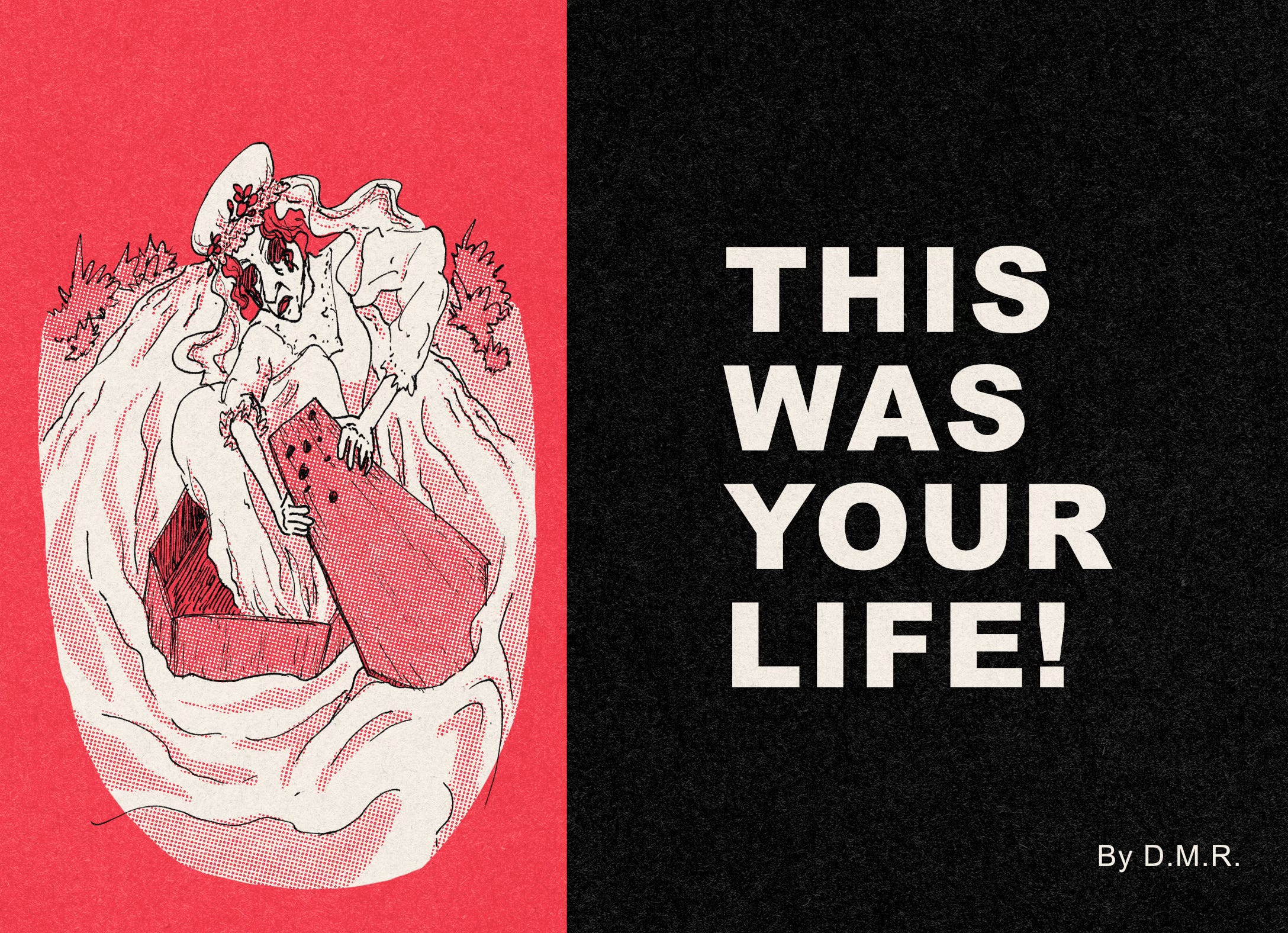
Back around the turn of the millennium, kids used to toss around hypotheticals concerning the Rapture. What if He returns right after you’ve told a lie? Or let’s say you just imagined a dirty picture in your head, what if He arrives in that moment? What if it’s right before you had a chance to ask for forgiveness?
I remember a song that so represented the frame through which we considered these things. It was a ska tune, and it had a bouncy little refrain—”Do you know where you’re gonna go?“—which we sang a lot:
A 747 fell out of heaven
Crashed through the roof of a 7-11
You’re workin’ on a slurpee
Things get hazy
Reach for a twinkie now you’re pushing up daisies
Do you know where you’re gonna go?
This sense of urgency about our imminent yet unknown finitude was mundane and constant. When I look back from where I am now, the Rapture stuff, the end of the world-ness of it all, has slipped into the comic margins of history like every other worked-up chiliastic movement of the past, through the “Great Disappointment” of the nineteenth-century Millerites back at least until Christ’s original apostles themselves, for whom so many recorded statements drip with the expectation that not even one generation would pass before He would return in glory.
But within and behind the eschatological schoolyard musings was a children’s calculus of moral reckoning that I think is still relevant. It mattered back then to figure out the instant of the ending because moral status was all black and white, binary, saved or damned based on a status conferred through an act of speech that we called “asking God for forgiveness of our sins.” One minute, you’ve told a lie, and you’re damned. The next minute, you’ve asked forgiveness, and you’re saved. In speculating about the time that would befall us, we feared the consequences that would follow from our moral status: children for whom an act, unuttered in prayer, could mean a grim eternity.
///
In a literary sense, death may be a threshold: a point of transposition from one plane on to another. Or rather, a curtain call, but in which one might imagine a second play happening on the other side, about which we can only speculate. All the world’s a stage and all the men and women merely players, but what about after the world, beyond the world? Could be other performances happening there. And then here in the general admission section, among the audience, that’s a play happening there too. In some ways, the audience is the space of continuity, because when the first play ends and the second, behind the curtain, might be beginning, the rest of us in the third are carrying on, getting up from our seats, talking over what we witnessed and what it meant, heading outside for a cigarette and a walk to our next destination.
William Faulkner’s novel As I Lay Dying tells the story of a rural Southern family, the Bundrens, witnessing and responding to the death of their mother Addie. From the threshold scene of her final breath in the bedroom, the narrative turns from chamber drama to odyssey as the Bundrens transport her body across the county to her ancestral home in Jefferson, where they had promised they would bury her. The trip takes several days, her corpse rotting all the while, and they cross a flooded river and a burning barn along the way, thus venturing through multiple Christian symbolics of death and resurrection, baptism and salvation.
The novel is remembered for its use of a fragmented pluralist narrative voice. Each chapter is titled by a character’s name and, as the conceit goes, told through their unique point of view. Many high school English classes teach the novel as exemplary of high modernism’s interest in “stream-of-consciousness” style. Virginia Woolf declared that modern fiction must take a concerted interest in psychology, how a human mind processes experience, combining sense-impressions with sense-making. The narrators of As I Lay Dying exhibit stream-of-consciousness narration to varying degrees of immediacy and illustrate various ways of making sense of the unutterable. These modes of narration reflect the character’s preoccupations, as well as their individual modes of processing consciousness’s objects.
For instance, the daughter Dewey Dell, alone among brothers and a useless father, expresses a spiraling immediacy in her chapters as she dwells on the barely articulated fact of her unwanted pregnancy and her need for an abortion. One short chapter spans only the time it takes the family wagon to pass a sign on the road. It begins, “The signboard comes in sight. It is looking out at the road now, because it can wait. New Hope. 3 mi. it will say.” Dewey Dell prays that they ultimately pass New Hope by (in a deflating irony of the town’s name) so that she can secure her abortion in the farther town of Jefferson. As they arrive at the moment of truth, she focuses elliptically on what she has lost:
I heard that my mother is dead. I wish I had time to let her die. I wish I had time to wish I had. It is because in the wild and outraged earth too soon too soon too soon. It’s not that I wouldn’t and will not it’s that it is too soon too soon too soon.
Now it begins to say it. New Hope three miles. New Hope three miles.
She struggles to finish a thought at almost any point in the novel as her narration continually takes on the contours of panic. Her sentences often lack objects and predicates, instead relying on vague pronoun references and compulsive repetition. (”He could do so much for me if he just would. He could do everything for me.”) She, almost alone among the characters (her mother being the exception), is someone with a big secret: this pregnancy that she wishes undone, the virtual void within her and within her narration pulling all the articulations into its center of gravity. In the immediacy of this moment on the wagon, she experiences relief as they do, it turns out, pass by the turn: “It blows cool out of the pines, a sad steady sound. New Hope. Was 3 mi. Was 3 mi. I believe in God I believe in God.” Her belief hangs on the renewed possibility of securing a life for herself despite the bonds necessitated by the pathetic patriarchy of this broken family. And yet her confession of faith erupts out of this immediacy, the glint in the river rapids of time that something may yet be otherwise. What of such faith when there are many taut immediacies to come?
I don’t intend to go into this kind of detail for all the characters. Really, I just want to talk about Addie, the dead mother. By way of overview, Dewey Dell’s immediacy of obsession and panic contrasts with her father Anse’s monologous lazy self-justifications, stuffed with platitude (”I tried to do as she would wish it. The Lord will pardon me and excuse the conduct of them He sent me.”); her eldest brother Cash’s pragmatic, almost neurotic, level-headedness (”It wasn’t on a balance. I told them that if they wanted it to tote and ride on a balance they would have to...”); her brother Darl’s unwinding lyric sensitivity to the cosmos and to the soul, spoken as though from both within and without the narrative chronology (”We go on, with a motion so soporific, so dreamlike as to be uninferent of progress, as though time and not space were decreasing between us and it.”); her brother Jewel’s fury and despair, briefly uttered early on and then left for others to name (”...because if there is a God what the hell is He for.”); and her youngest brother Vardaman’s childlike logical positivism, attempting to comprehend the incomprehensible family dynamic, amid loss, via a chain of inferences, semantically structured as though derived from abstract reason but really more referring to metaphorical contiguities in his immediate concrete experiences (”My mother is a fish.”)
For about two thirds of this book, all these narrations—these various ways of voicing grief—orbit around the black hole at their center: the person lost in the event of loss. Then, Faulkner gives us, for my money, one of the most remarkable passages in all of American literature: the voice from beyond the grave, dropped in from some time beyond time, the “Addie” chapter.
///
In the structure of the novel, the Addie chapter is given to us sandwiched between two overtly evangelical meditations on sin and salvation. In arriving between them, this singular chapter begs the question of what American Christianity misses of the human experience in its keening obsession with moral status, its sickness unto death.
Before the chapter, we have a point of view on Addie from her busybody church-lady neighbor Cora Tull. Cora’s way of narrating relies on heavy use of evangelical religious idioms, which afford her a pat self-satisfaction through easy judgments of the other characters, not least of Addie. Cora feels Addie dotes on her favorite child Jewel in a sacrilegious way, an idolatry of affection that places him before Christ, who could save her. Cora recalls the summer that the camp revival meeting arrived to town, during which the Reverend Whitfield wrestled with Addie’s spirit (as Cora puts it). In Cora’s view, Addie is woefully damned, “lost in her vanity and her pride, that had closed her heart to God and set that selfish mortal boy in His place.” To Cora, salvation happens in the intentional priorities of the heart: the asserted thought of submission and to whom one submits in that thought.
So, we get classic old-time religious judgment in Cora’s prologue to the Addie chapter, and we get much the same in the epilogue to the chapter with Whitfield’s portion, which participates in the literary genre of Christian confession. He recounts his short journey to the Bundren home, burdened with the guilt of sin. We learn from Addie that Jewel was the product of an affair between her and Whitfield. The name, I think, is meant to nod to the history of revivalist preachers during the so-called First Great Awakening in the United States, in which early evangelicalism was propagated through the charismatic speaking tours by the likes of Jonathan Edwards and, to note, George Whitfield. The name Whitfield, then, makes this confessional meditation of sin, hypocrisy, and the desire for redemption feel like its an archetypical expression of American religiosity. Whitfield, it turns out, is saved before ever needing to confess, because the one who bore his secret took it to the grave. He learns that Addie has already died:
I knew then that forgiveness was mine. The flood, the danger, behind, and as I rode on across the firm earth again and the scene of my Gethsemane drew closer and closer, I framed the words which I should use. I would enter the house; I would stop her before she had spoken; I would say to her husband: “Anse, I have sinned. Do with me as you will.”
It was already as though it were done. My soul felt freer, quieter than it had in years; already I seemed to dwell in abiding peace again as I rode on. To either side I saw His hand; in my heart I could hear His voice: “Courage. I am with thee.”
The drama of sin and salvation takes place in the unuttered words of the human heart and the imagination of words in return: an Idealist dialectic in which action and event occur in the speculative hereafter, and how a person feels about that—how they think about it, in what language they think it—determines the role they will perform in that someday play.
///
Addie’s chapter ends with the following lines, which lead then directly into the Whitfield portion I just described:
One day I was talking to Cora. She prayed for me because she believed I was blind to sin, wanting me to kneel and pray too, because people to whom sin is just a matter of words, to them salvation is just words too.
It’s the brutal edge of Addie’s consummate critique that makes me love this chapter. In its literary structure, Faulkner makes us read this perspective in ironic contrast to the two surrounding it. In the secret center between the histrionic and blustering evangelical assertions about the narrow way to heaven—all the pomp and circumstance that comprise the discursive theater of judgment and confession—we have the wisdom of a dead woman, stepping back from what was her life, directing our ears to the hollow sound of all those words, words, words.
As I noted above, the vast bulk of these narrative voices rise out of the whirlpool of immediacy. Addie’s segment, instead, looks backward from outside the flow of time. It is an essay, an exercise in thought using the materials of a life already lived to compose a statement. In her essay on life, she writes about the failure, the irrelevance, of words to describe experience. Life is not the same as living; death is not the same as dying. She understood this, but her family, least of all her husband, did not:
He had a word, too. Love, he called it. But I had been used to words for a long time. I knew that that word was like the others: just a shape to fill a lack; that when the right time came, you wouldn’t need a word for that anymore than for pride or fear.
As a critique of Cora’s and Whitfield’s evangelical Christianity, I think Addie’s implication is that the people who talk the most about sin and salvation are the ones who have least grappled with it. Words are easy. They hold the place of something more challenging, something more violent. She remarks on “how words go straight up in a thin line, quick and harmless, and how terribly doing goes along the earth, clinging to it, so that after a while the two lines are too far apart for the same person to straddle from one to the other...” Air and earth, saying and doing, life and living: in the span of years you are given, during which you just prepare to be dead a long time, you may be a Christian in the clouds or a serpent on the earth, but you can’t be both and keep your wits about you.
///
In all our schoolyard musings on the Rapture, we were simply speculating on two things we fundamentally could not comprehend, those being death and the self. Life keeps happening in an unstoppable series of immediacies, and back then we wanted some consummate idea to comprehend it all. Meanwhile, we had to live, to choose, to move about the earth, which is always turning.
Some believe that one day a trumpet will sound, the dead will rise, and the rest of us who remain will be caught up together with them in the clouds to meet the Lord in the air. But when they believe that, they stake a living debt on that speculation. They then must move about the earth with that debt before them.
It’s one cosmic company town, and the economy runs on the scrip of sin and salvation. You can acquire the proper insurance through (and only through) your employer. The debt shall be redeemed. Great ventures necessitate speculation, and it’s your responsibility to labor through your life as an investment in the hereafter. What will you have to show for it when the big boss arrives? Will you be ready?